Saturday, June 7, 2014

Your Choice


At the store, we've got plenty of choices for bathing products. They're all one or another variety of soap, usually with stuff added.  They're almost all necessary, of course.
Bars of soap along with other common products;
corn meal, rice, salt, sugar, oil, pasta ...

For comparison, note the blue bars in the photo (right).
That's soap in Africa and perhaps for much of the world. The large bar is cut off in chunks and used for laundry, for bathing, for hair washing, and pretty much everything along that line.  It's not bad, really.  It's used in school and home and at the river where they do laundry and dishes, and it works fine.  

So how much does our culture shape us?  We know you have to have at least five kinds of soap, and you can't dry clothes without using a softener sheet, and men and women can't use the same deodorant.  True?  OK, five kinds of soap: bath, hair, dish, laundry, and nice smelling stuff for shaving.

Do we maybe over-do it a bit?  The proliferation of stuff in our lives is at least in some measure force-fed to us by a profit-driven marketplace and social acquiescence.  Much if not most of it all isn't worth the time and effort, much less the money.


You can choose, despite the social and marketplace pressures.  You can strive to have everything and lots of it, like your culture insists, or you could choose ... to live quite simply, and leave some room in your budget thanks to the absence of excess.  Then you could do things with your kids or help others or put your kids through school without going into debt, perhaps.  Or travel.  Thoughts?

Just an aside, the cost of the bathing products (top, left) would pay for the products and school uniforms (top, right) plus tuition and fees for a semester, around $45 or so.  Feel like joining the assistance effort?  It's tax deductible!

And on a fun note, I took some kids with me on a trip to a little grocery store for momma.  One pre-teen discovered the nice smelling bath soap (Dial or Dove or something like that); she figured it was really special, so she excitedly asked if I could buy a bar for the kids to use.  Of course.

Saturday, May 24, 2014

At Play

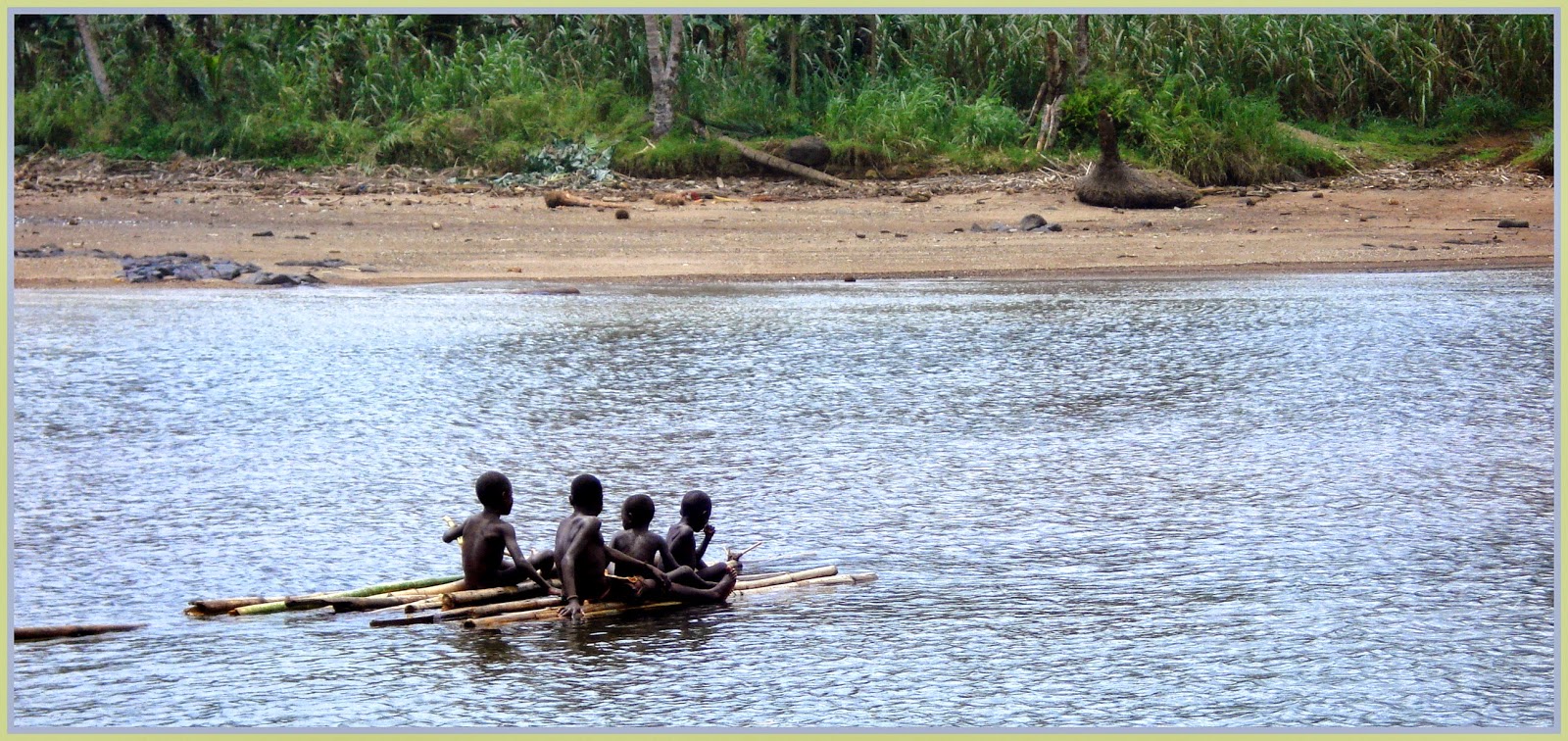
At play on a sunny afternoon, boys ride on the raft they threw together from local bamboo.  I remember doing the same on a pond with friends when I was a kid in Texas.

Up by the waterfall, moms do the family laundry.
(You can click on the pictures to see them full sized.)
Down the eastern shore of Sao Tome & Principe, an African island country, the mountain river flows over a waterfall into the inlet where they play.  Moms do laundry up near the falls before the fresh water mixes with the salt ocean.

No tourists, no hotels; a local fellow invited me down to see the village and meet folks that live there.

Kids learn to swim early on.  No Red Cross swim classes like where I grew up.  They teach each other in the course of growing up.

The kids stand on a sandy beach, but the rocky
 shoreline is from the island's volcanic origin.
The only work for fathers here is fishing, and that's troublesome.  Illegal fishing by wealthy countries has seriously depleted the pelagic fish populations in the Gulf of Guinea.  The gulf's coastal communities who depend on fishing have been the ones most harmed. International efforts to stem the illegal activity have had minimal success; it will be a century or more before the populations recover.

An almost-road leads down through the tiny village
to the shore and the waterfall.  The cobblestones are
a leftover from the early 20th century.
Fortunately, unlike much of equatorial Africa, the climate here supports a fairly prolific ecosystem. Breadfruit, bananas (maybe 5 different types), jackfruit (jaque), and mangoes, all are commonly available.

The kids from a family took me by the hand to go with them to get mangoes.  I thought we were going to a kiosk vendor, but they took me to a tree along the pathway and threw sticks up into the tree until they had a dozen or so, then we went home.

My friend and work partner Freddie had an
interesting problem.  When we traveled
together, folks would insist on talking to
him in Portuguese.  Since he's black,
obviously he would speak Portuguese!
Not a word, unfortunately.
Unlike much of Sub-Saharan Africa, they have enough rain here.  It feeds the rivers and the countryside well enough.  You can use a banana palm leaf for an umbrella if you get caught out in the rain; that's what they do.

As tough and practical as the folks here are (and must be in order to live), they are comfortably hospitable.  We were welcomed pretty much everywhere we stopped.  Community leaders, school faculties, government officials, police and military, all were approachable and graciously receptive.  It's a nicer place than most.

Monday, May 12, 2014

At home ...

Intelligent design for house ventilation ...
Passive cooling; it's an ancient solution.
Among the nicer homes, I noticed the floors are deliberately ventilated; a rather precise gap.

It's an interesting design.  Hot air rises out of the roof vents, cooler air from underneath the house is drawn in.

Near the equator, the weather is predictable.  Many houses are intelligently designed to circulate the air without the expense of air conditioning. Some leave a shaded area under the house; an extended living/cooking area.  Nicely done.

Photos discovered among the thousand-plus the kids took with my cameras.

Friday, April 25, 2014

Cheek Pinch

Note the 'cheek pinch' in the front row.  Delightful kids.
Kids and sticks.  It's grasshopper season in southern Kenya.  These kids are out hunting grasshoppers which are a seasonal delicacy, I'm told.  Fried or boiled, they're ready in minutes. My wife says they're pretty good in a sauce over rice.  I'll take her word for it.

Working in eastern and western Africa, I've been offered a variety of things to eat; most were pretty good. One family adopted me. At a weekend family meal, I offered to bring things and make the salad.  As I stood at the table slicing tomatoes, the women watched wide-eyed like they were afraid I'd cut off my fingers or something.  I later found out that men NEVER do food preparation.  When I asked the men if they liked to cook, they were speechless.  Live and learn.

Our friend, an African bishop, met the kids in the picture while visiting a village we know.  It's located in the coastal plains outside Mombasa.  Nice folks in a harsh place.  The last couple of decades have brought persistent drought, so crops, forests, and flocks have suffered.  A difficult life. For now, Bishop Samuel is working on small assistance projects for the neediest.  He hopes to build a little church/community center there to begin the work of community development.  If you'd like to join in, drop me a note.  Or better yet, if you'd like to see for yourself, we'll provide introductions!

Saturday, April 19, 2014

By the Sea

On the eastern shore, this community is home to fishermen and their families. Boats are handmade and simple; they've been doing it this way for centuries.

The shore here is just across the road from their homes.  Kids come here to play in the water and watch dad do fishing things like mending the nets.  It's 85 and sunny pretty much every day.

Down the street and around the corner, there's an elementary school.  Making it through the 6th grade is a big deal, and not all make it that far.

There's a middle school and a high school in the capital city, but only a small percentage of kids in the country get to go there.  Still, it's encouraging to see the mob of kids in the city going to and from school.

Like all such efforts, it serves well for a percentage of the folks they hope to serve.  Out on the edges are more who can't afford the fees and uniforms and supplies needed.

STeP UP Sao Tome is a local NGO, a really energetic bunch.  They manage several scholarship and assistance efforts.  For educational assistance, they focus on those who need a little help making their way forward; orphans, distressed families ...   If you want to go and see for yourself, they'll take you in like they did for us.  Want an introduction?


Just minutes from our work site, this fishing community is organized under
the supervision of a 'beach captain', the local elder who keeps up with
boats and landing spots and who's missing at the end of the day.

The country is Sao Tome & Principe, by the way.  Need more incentive to go see for yourself? Nice hotels, guest houses, incredible beaches, and no crime or violence.  And good food, no matter where you eat.  Local folks are among the world's most gracious; if you ask politely, they'll let you take their picture.  :)

On the equator, the two-island country is much like Hawaii for climate, terrain, and foliage.  The rainy season isn't a bother, and the dry season is perfect for shorts and sandals.  At sea level, the climate is tropical - hot and humid with average yearly temperatures of about 27 °C (80.6 °F) and little daily variation. The temperature rarely rises beyond 32 °C (89.6 °F).

At the interior's higher altitudes, the average yearly temperature is 20 °C (68 °F), and nights are generally cool. Kids who live there complain about having to wear long sleeve stuff and having covers for their beds.  Annual rainfall varies from 5,000 mm (190+ in) on the southwestern slopes to 1,000 mm (39 in) in the northern lowlands. The rainy season runs from October to May.

Wednesday, April 16, 2014

Opportunity

We all love the chance to do or see or experience something exciting and new.  So the fellow here in the blue shirt is like that.  His name is Samuel, and he's an African bishop, the father of 20+ churches scattered across southern Kenya and into Burundi.  His great pleasure in it all is introducing folks to real life, real community, and real faith.

I got to spend some time with him in Kenya.  He's an extraordinarily practical fellow; not a lot of tolerance for religiosity.  He encourages folks to live the larger life of caring for one another and making a way forward together.

A community kitchen cooking cornmeal for school kids,
part of an assistance project Samuel and friends manage.
From Samuel recently, " The Sunday service was great especial when you practice what you preach. Two young girls 10 & 13 years old walked for over an hour to reach us.  After the service they came jp front for prayers. They begun weeping crying. I cooled them and asked what was the problem. They said their father was killed. The mother divorced when they were little babies; got married to another man. They stayed with their father's family but because of poverty these girls were chased away. They tried to go to their mother; they found out the mother mind went berserk and mad.  The family rejected and refused to accept them. Coming to our church was their last solution. The tears and the story were touching. We gave; we sowed the seeds of love and kindness. We trust we will be able to locate an orphanage to take them this week."
 
Bishop Samuel and friends delivering water
during a recent drought.
Then, "I am glad that God our father makes a way where there is no way. The two girls will be taken by Barnabas Children Centre, Utange."

Samuel tells us later, "They say they were denied food, mistreated, and forced to drop from school Am glad we are there to help."

So here's an opportunity to help, to make a difference that will last a lifetime.  If you want to help Samuel in his work or perhaps provide support for the two girls, drop me a note. 

You can go see for yourself, too.